
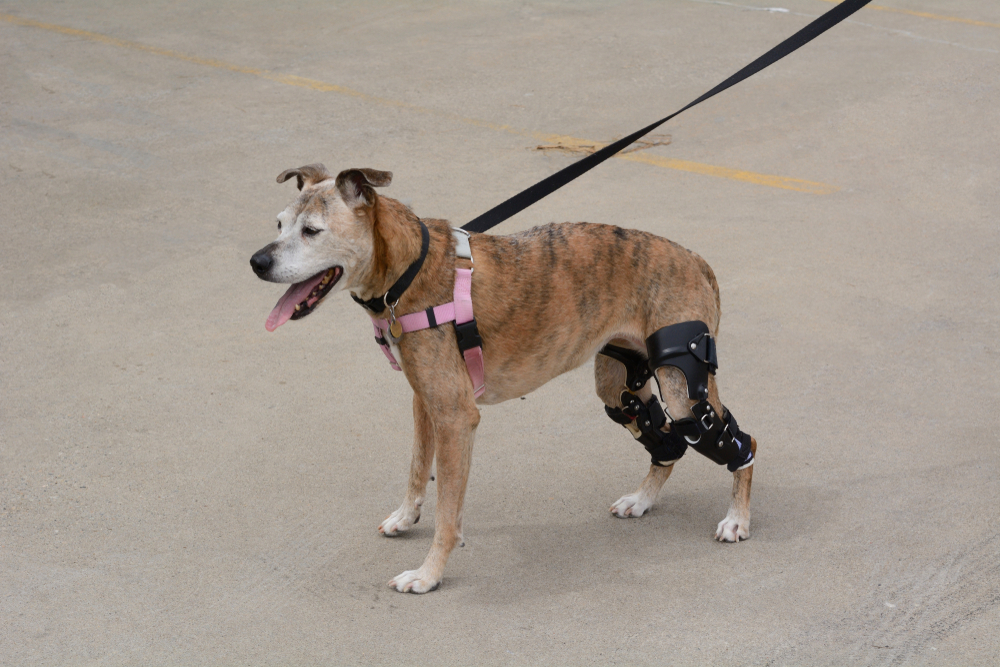
A dog who suddenly limps on a back leg has very often torn the cranial cruciate ligament, the knee stabilizer that is the canine equivalent of the human ACL and one of the most common orthopedic injuries we see. It is not the only cause of a hind-leg limp, which is exactly why a sudden or lingering limp deserves a real diagnosis rather than a wait-and-see guess. A torn CCL leaves the knee unstable, and because the joint cannot restabilize on its own, the limp tends to either appear all at once after a hard play session or come and go for weeks as a partial tear slowly worsens.
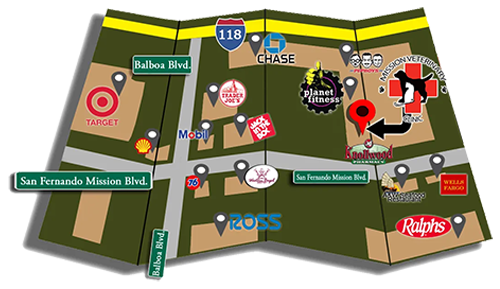
Mission Veterinary Clinic in Granada Hills works on a walk-in, triage-based system, so a dog who has suddenly gone lame can be seen and examined without a long wait. Our orthopedic and diagnostic services let us pinpoint the cause of a limp and lay out the options, including TPLOs for surgical correction. If your dog is favoring a hind leg, contact us and we will take a careful look.
Reading Your Dog’s Limp: The Essentials
- A sudden hind-leg limp in a dog is frequently a torn CCL, but it is not the only possibility.
- A limp deserves a real diagnosis, because the right treatment depends on the actual cause.
- A CCL tear leaves the knee unstable and will not heal with rest alone.
- Catching a partial tear early, while the limp is still intermittent, leads to better outcomes.
What Does a Torn CCL Limp Look Like?
The way a CCL injury shows up depends on whether the ligament has partly or fully torn. A complete tear is dramatic: a dog who was fine moments ago suddenly will not put weight on a hind leg, often holding it up entirely. A partial tear is quieter and more common, producing an intermittent limp that eases with rest and returns with activity, which is easy to mistake for a passing strain. The clues below help you read what you are seeing.
| What you notice | What it may mean |
| A sudden refusal to bear weight on a hind leg | Often a complete CCL tear |
| An on-and-off limp that worsens with activity | Frequently a partial CCL tear |
| Sitting with the leg kicked out to the side | Knee discomfort, a classic CCL sign |
| A click or pop when walking | Possible meniscal involvement |
| Stiffness after rest that eases with movement | Joint inflammation and early arthritis |
Beyond these, dogs with a sore knee often hesitate at stairs, balk at jumping onto furniture, and show subtle swelling at the joint. The intermittent pattern is the one most often shrugged off, yet acting on it early, before a partial tear becomes complete and the meniscus is damaged, makes a real difference.
Could the Limp Be Something Other Than a Torn CCL?
It can, which is the whole reason a limp warrants an exam rather than a guess. Several other problems produce a similar hind-leg lameness, and they call for very different treatment. A luxating patella, where the kneecap slips out of its groove, can cause a skipping or intermittent limp, especially in small breeds. Hip dysplasia or hip arthritis can look like rear-leg weakness or stiffness. A simple soft-tissue strain, a torn nail, a foot-pad injury, an insect sting, or something lodged between the toes can all make a dog favor a leg, and in older dogs even a bone tumor has to be ruled out.
Because the cruciate ligament injury pattern overlaps with these other causes, the only reliable way to know what you are dealing with is an exam that tests the knee specifically. Treating a suspected CCL tear as a strain, or vice versa, wastes time the joint does not have.
Why Do Dogs Tear Their CCLs in the First Place?
This is the part that surprises most families: a canine CCL tear is usually not the result of a single bad moment. In humans, an ACL tear is almost always an acute injury, the kind of pivot or hard landing an athlete remembers. In dogs, the picture is different. The vast majority of CCL tears are degenerative, meaning the ligament has been quietly weakening over months or years before it finally gives way during something as ordinary as jumping off the couch or running across the yard. The “what was she doing when it happened” question often has a disappointing answer: she was just being a dog.
Several factors increase the risk:
- Breed. Labrador Retrievers, Rottweilers, Newfoundlands, Boxers, English Bulldogs, Mastiffs, American Staffordshire Terriers, and German Shepherds carry meaningfully higher rates than the average dog. Larger breeds in general are at higher risk.
- Weight. Excess body weight is one of the strongest risk factors. Every extra pound increases the load on the ligament with every step, and over time that wears the ligament down. Overweight dogs tear CCLs at much higher rates than lean dogs of the same breed.
- Conformation. The angle of the stifle joint and the slope of the top of the shin bone (the tibial plateau) both affect how much shear force the ligament has to resist. Some dogs are simply built in a way that puts more daily strain on the CCL.
- Age. Most CCL tears happen in middle-aged dogs, typically between 4 and 10 years old, after the ligament has had time to degenerate.
- Existing knee problems. Dogs with patellar luxation, prior knee injuries, or chronic stifle inflammation are at higher risk because the joint is already not moving normally.
- Spay/neuter timing in some breeds. Recent research suggests that very early spay or neuter in certain large breeds may increase CCL injury risk later in life, which is why we have nuanced conversations about timing for at-risk breeds.
True acute injuries do happen. A dog slipping on ice, getting hit by a car, or landing badly off a high jump can tear an otherwise healthy ligament. But these cases are the minority, and even in dogs whose tear seems clearly traumatic, the ligament was often already partly compromised. This degenerative nature is also why dogs who tear one CCL frequently tear the other one within a year or two: the same factors that weakened the first ligament are usually still weakening the second.
The other thing worth knowing is the meniscus. The meniscus is a small cartilage cushion in the knee, and when the ligament tears and the joint becomes unstable, the meniscus often tears too, either at the time of the original injury or in the weeks afterward as the joint moves abnormally. A torn meniscus adds its own pain and instability, and addressing it is often part of the surgical repair.
How Do Veterinarians Diagnose a Torn CCL?
Diagnosis combines a hands-on orthopedic exam with imaging. The defining test is the cranial drawer sign, in which the veterinarian checks for abnormal forward movement of the shin bone relative to the thigh bone; a related test, the tibial compression test, looks for the same instability under load. Because a tense or painful dog can guard the leg and mask the motion, light sedation is sometimes needed for an accurate exam.
Imaging confirms the picture and guides the plan. Radiographs assess the bone, reveal how much arthritis has already formed, and show supportive signs like joint swelling, while MRI is reserved for complex cases or when other knee structures need detailed evaluation. Most CCL diagnoses are confirmed with the exam plus X-rays, and our walk-in system means a sudden limp can get that workup quickly rather than waiting for an opening.
What Should You Do Before the Appointment?
While you arrange to be seen, the goal is to keep your dog from making the injury worse.
- Limit activity to short, leashed bathroom trips, and skip stairs, jumping, and play until the knee has been evaluated.
- Confine your dog to a small, calm space rather than letting them run the house or the yard, because a single hard sprint can turn a partial tear into a complete one.
- Do not give human pain relievers, many of which are toxic to dogs, and call us about safe options if your dog seems uncomfortable.
If the limp is severe and your dog will not bear any weight, treat it as a reason to come in promptly rather than waiting it out.
Why Does a Torn CCL Need Treatment?
Once the ligament tears, the knee stays mechanically unstable, and that instability is the problem, not just the pain. Every step lets the shin bone slide abnormally, grinding cartilage and driving arthritis forward, and the meniscus often tears as a secondary injury. Rest may quiet the limp for a while, but it cannot rebuild the ligament or restore stability, so for most medium and larger dogs the joint never truly recovers on its own. Left untreated, a CCL tear tends to mean a progressively painful, arthritic knee and extra strain on the opposite leg, which is why timely treatment matters.
What Are the Treatment Options?
The right treatment depends on the dog’s size, age, activity, and the severity of the tear. For most medium, large, and giant dogs, surgery restores stable function far more reliably than rest and medication alone.
The most common procedure is TPLO (tibial plateau leveling osteotomy), which reshapes the top of the shin bone to change the joint geometry so the knee is stable even without the torn ligament. The principle is elegant: rather than trying to replace the ligament, TPLO eliminates the need for it by removing the slope that produces the abnormal sliding motion in the first place. Recovery is well-defined, outcomes are reliable, and TPLO has become the standard of care for most active medium and larger dogs.
Other surgical options exist depending on the dog. TTA (tibial tuberosity advancement) is a related procedure that also changes the joint mechanics, often used for specific anatomic situations. Extracapsular repair, sometimes called the lateral suture technique, uses a heavy suture outside the joint to mimic the function of the torn ligament; it works well for smaller dogs and is less expensive, but it tends to be less durable in larger, more active dogs over the long term.
For very small dogs or those who genuinely cannot safely undergo anesthesia, conservative management is sometimes the right path. This involves strict activity restriction for 8 to 12 weeks, anti-inflammatory medication, joint supplements, weight management, and rehabilitation exercises to build the supporting muscles around the knee. Some small or older dogs do reasonably well with this approach, though for an active medium or large dog it usually trades a defined surgical recovery now for chronic pain and progressive arthritis later. We walk through which option fits your specific dog rather than applying a one-size-fits-all answer, including an honest conversation about cost, your dog’s activity goals, and what realistic outcomes look like for each path.
What Does Recovery Involve?
Recovery after surgery is a staged process over about three months, and the dogs who do best are the ones whose families take the early weeks seriously. The general arc:
- Weeks 1 to 2: Strict crate rest with leash-only bathroom breaks, no stairs, no jumping, no play with other dogs. This is the hardest stretch because most dogs feel better than they should within a few days, and family members are constantly tempted to let them do “just a little” more. The structural healing happening in the bone underneath isn’t visible from the outside, and pushing too soon is the most common reason recoveries go sideways.
- Weeks 3 to 6: Gradually lengthening controlled leash walks, still no off-leash activity, still no stairs or rough play. A recheck X-ray around week 6 or 8 confirms the bone is healing as expected.
- Weeks 7 to 12: Progressive increases in activity, sometimes with the addition of structured rehabilitation work. Most dogs return to controlled normal activity around the 12-week mark.
Structured rehabilitation is one of the strongest predictors of a great long-term outcome. The surgery creates the mechanical correction; rehabilitation rebuilds the muscle, balance, and proprioception that turn a structurally healed knee into a fully functional one. Dogs who skip the rehab piece often heal acceptably but never quite get back to their pre-injury function.
Over the long term, two things matter most:
- Weight control: keeping your dog lean is the single highest-impact thing you can do to protect both knees and reduce the arthritis that follows any CCL tear.
- The other knee: Because most CCL tears are degenerative rather than purely traumatic, the opposite ligament is often weakening at the same time, and 40 to 60% of dogs who tear one CCL will tear the other within one to two years.
We watch the contralateral knee at every recheck, and a return of intermittent lameness in the other leg is the kind of thing we want to know about right away rather than waiting for a complete tear. Gentle warm-ups and cooldowns around any vigorous activity, along with avoiding the slippery floors and high jumps that most often trigger the second tear, can meaningfully reduce that risk.
Frequently Asked Questions About a Limping Dog
My Dog Was Limping but Seems Fine Today. Should I Still Have It Checked?
It is worth a check, especially if this is not the first time. An intermittent limp that comes and goes is the classic sign of a partial CCL tear, and the good days do not mean the ligament is healing, only that the joint is calmer for the moment. Each flare reflects ongoing instability, so having it examined while it is still intermittent gives your dog more and better options than waiting for a complete tear.
Can a Torn CCL Heal With Rest?
For most medium and larger dogs, no. The ligament cannot reattach across a constantly moving joint, so rest may ease the pain without restoring the stability that was lost. Very small dogs sometimes stabilize acceptably with conservative care, but for an active dog, rest alone usually means a knee that stays unstable and steadily more arthritic.
Can My Dog Tear the Other CCL?
It is a real risk. Roughly 40 to 60 percent of dogs who tear one CCL go on to tear the opposite knee within one to two years, partly because that leg carried extra weight during recovery and partly because the same degenerative process is often at work in both ligaments. Keeping your dog lean and conditioning steadily lowers the odds, and we watch the other knee at rechecks.
How Soon Should I Bring My Limping Dog In?
A sudden, severe limp, especially one where your dog will not bear weight, is worth having examined promptly rather than waiting several days, both for pain relief and because an unstable knee keeps doing damage. A mild, intermittent limp still deserves an exam soon, even if it is not an emergency. Our walk-in system is designed so a lame dog can be seen without a long delay.
Getting to the Bottom of the Limp
A sudden hind-leg limp is one of the most common ways a torn CCL announces itself, but because other injuries look similar, the path forward starts with a clear diagnosis. Once we know what is causing the limp, we can match the treatment to your dog and protect the joint for the long run.
If your dog is limping or favoring a back leg, contact us or come in, and our team will examine the knee and walk you through what we find and the services that can help.