
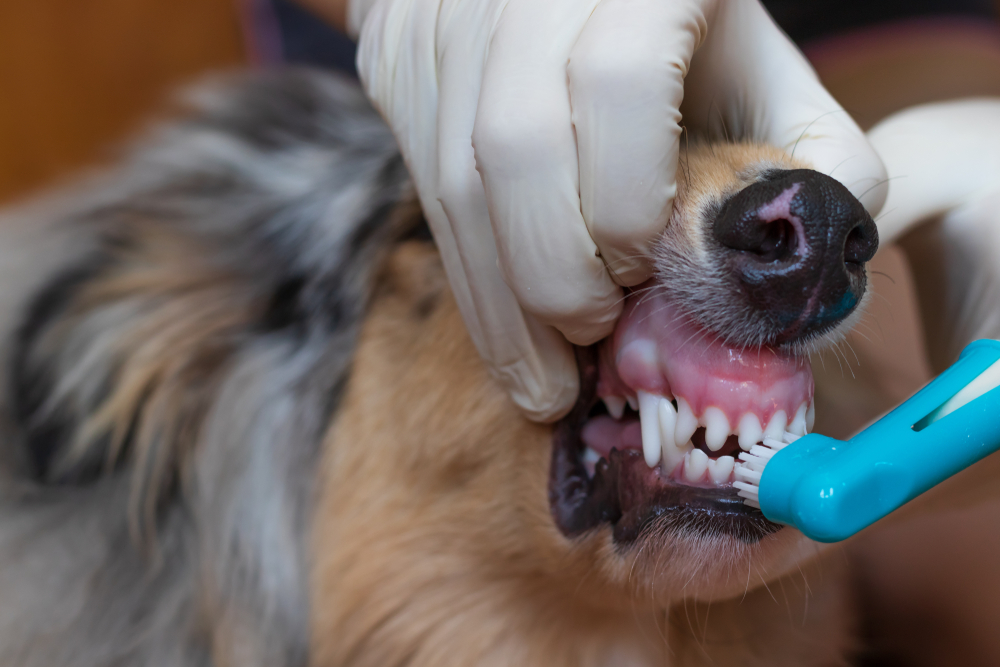
Good dental care works best in layers. Daily brushing helps control plaque at the gumline, dental chews can supplement that routine, and professional cleanings address buildup that home care cannot remove. Dental care does more than stop bad breath: it holds back the gum disease that lets mouth bacteria slip into the bloodstream, where chronic infection strains the heart, kidneys, and liver. Every layer of care, from the brush to the right chew to a professional cleaning, trims that burden before it builds. The encouraging part is that this whole chain has a starting point you can control, and it’s the gumline.
Dental disease is one of the most common problems we find during exams at Mission Veterinary Clinic, and after more than 20 years serving the San Fernando Valley, we’ve seen how rarely it stays politely confined to the mouth. Our dentistry for dogs and cats includes digital dental X-rays that show what’s happening beneath the gumline, in-house bloodwork that lets us check if the internal organs are affected, and ultrasound plus chest X-rays that let us evaluate heart health. Give us a call before heading our way and we will make sure your pet’s whole health gets a proper look.
Teeth, Hearts, and What We Actually Know
- Periodontal disease is a bacterial infection of the tissues around the teeth, and most of the damage happens below the gumline where you can’t see it.
- Bacteria from infected gums enter the bloodstream every time a diseased mouth chews, and that steady exposure can fuel inflammation that reaches the heart.
- A professional cleaning under anesthesia with full-mouth X-rays is the only way to treat disease below the gumline, where the trouble actually lives.
- Daily brushing, backed by products with proven results, is the simplest way to slow the buildup between cleanings.
What Are the Early Warning Signs of Heart Disease in Dogs and Cats?
The earliest signs of heart disease are easy to miss and easier to blame on aging: a cough that worsens at night, tiring quickly on a walk, faster or harder breathing at rest, and the occasional fainting spell. Cats hide cardiac trouble so well that rapid or open-mouth breathing is often the very first clue anyone gets.
How fast to act depends on what you’re seeing:
| What you notice | How fast to act |
| A mild cough that flares at night, slowing down on walks | Get in this week |
| Breathing faster or harder at rest, all-day cough | Same-day visit |
| Open-mouth breathing in a cat, collapse, blue or gray gums | Emergency, right now |
Small-breed dogs deserve special mention, because they draw the short straw twice: they’re the most prone to mitral valve disease, the slow-leaking valve condition that is the most common heart problem in dogs, and their crowded mouths put them at higher risk of severe dental disease. The combination is exactly why a small dog’s mouth is never just a cosmetic concern.
When symptoms of heart disease appear, chest X-rays, cardiac ultrasound, and bloodwork through our in-house diagnostics give the first picture. We’re here around the clock for the urgent end of that table, but always call first, since we run on triage and may pause intake once capacity fills; if we’re full, we’ll point you to the nearest open emergency hospital rather than leave you circling the parking lot.
What Is Periodontal Disease, and How Does It Get So Bad?
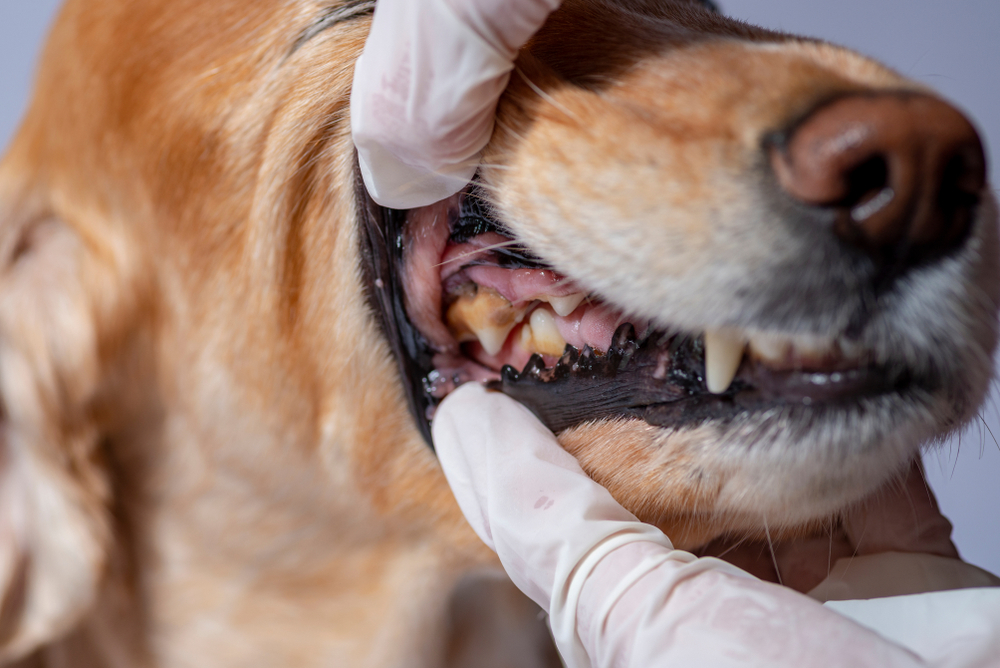
That eye-watering smell when your dog yawns in your face usually starts below the gumline. Periodontal disease is a bacterial infection of the tissues that hold teeth in place, and it gets bad because it builds quietly for months before anything shows: plaque hardens into tartar, bacteria colonize the pocket between tooth and gum, and the body’s own immune response destroys soft tissue and bone in the crossfire.
Visible tartar is only part of the problem. A mouth can look reasonably clean on the surface while infection dissolves the bone around the roots, and the disease moves through recognizable stages of periodontal disease along the way:
| Stage | What’s happening | What you might notice |
| Gingivitis | Gums inflamed, no bone loss yet | Red gumline, mild bad breath |
| Early | Up to 25% bone loss around the tooth | Tartar, tender gums |
| Moderate | 25 to 50% bone loss | Receding gums, obvious tartar buildup, worse odor |
| Advanced | Over 50% bone loss and infection around teeth | Loose teeth, pain, severe tartar, infection |
Caught at gingivitis, a professional cleaning can fully reverse the picture, which is why a thorough oral exam checks roots and gumline rather than only the visible crowns. Our dental exams and cleanings assess every tooth on every surface for exactly that reason.
Does Dental Disease Really Cause Heart Disease, or Is That a Myth?
The honest answer sits between myth and certainty. Dental disease has not been proven to directly cause heart disease, but the two appear together often enough, in dogs and in people, that the connection is real and worth taking seriously. Here’s what the research shows, and how the link most likely works.
What Have the Studies Actually Found?
Across large populations of dogs, the connection between gum disease and heart problems grows stronger as periodontal disease advances, with higher rates of heart valve inflammation and congestive heart failure in dogs whose mouths are in the worst shape. That dose-response pattern makes the findings hard to dismiss, even though correlation isn’t proof of cause.
The link has been studied far more closely in people, where poor brushing habits track with higher heart risk and gum disease travels with cardiovascular disease often enough to keep cardiologists concerned. Hearts and their diseases differ across species, but the underlying fact holds everywhere: chronic inflammation stresses the whole body, and a mouth is one of its most reliable sources.
How Might Mouth Bacteria Reach the Heart?
The proposed mechanism starts at the gumline. Gums inflamed by dental disease bleed easily, and every meal or chew session pushes bacteria through those damaged vessels into circulation. That steady exposure gives bacteria repeated chances to lodge on a heart valve and trigger endocarditis, a serious valve infection, and the relationship between oral health and heart disease may also run through quieter channels, with chronic low-grade inflammation adding strain to a heart already under pressure.
Plenty of dogs with gum disease never develop heart trouble. But pets already living with a murmur or valve disease sit at the higher-risk end, which is why our veterinarians fold a careful mouth check into every cardiac recheck rather than treating the two as separate problems.
What Happens During a Professional Dental Cleaning?
A professional cleaning is a full medical procedure under general anesthesia, not a quick scrape at the visible tartar. That’s what lets us clean under the gumline, image every root, probe every tooth, and treat what we find in a single visit, while your pet feels none of it.
Why Does a Real Cleaning Need Anesthesia and X-Rays?
More than half of every tooth sits below the gumline, so dental X-rays are the only way to find root damage, bone loss, and hidden infection down there. Anesthesia makes the rest possible: a complete, gentle cleaning beneath the gumline and careful probing of every tooth, none of which a wiggling, awake pet will tolerate. Awake cleanings, known as non-anesthetic dentals, polish the crowns you can see and leave the disease you can’t fully untouched.
What Does Procedure Day Look Like, Step by Step?
At our AAHA-accredited hospital, the day follows a clear sequence:
- Pre-anesthetic screening: Bloodwork confirms your pet is ready, and seniors or pets with known heart disease may get chest X-rays or a cardiac ultrasound first.
- Individualized anesthesia: Our team builds the protocol around your pet’s organ function and heart status, then monitors continuously.
- Full-mouth radiographs: Every root imaged to find hidden trouble.
- Scaling and polishing: All surfaces cleaned, above and below the gumline.
- Probing and charting: Each tooth measured for pockets and attachment loss.
- Monitored recovery: Warm, watched, and comfortable until fully awake.
Pain control is built into the plan from the start. When X-rays and probing turn up a tooth that’s fractured, infected, or beyond saving, an extraction is often the kindest choice, and we review every finding with you before deciding next steps.
How Do I Actually Protect My Pet’s Teeth at Home?
The most effective home care is the least glamorous: daily brushing, which keeps plaque from hardening into tartar and cuts down the oral bacteria and gum inflammation that seed the bloodstream. Chews, water additives, and dental diets cover the spots a brush misses. Small, consistent habits beat occasional heroic efforts every time.
How Do I Brush the Teeth of a Pet Who Wants No Part of It?
Start brushing slowly, and on their terms. Start by letting your pet lick a pet-safe toothpaste off your finger, graduate to a finger brush or wipes over a couple of weeks, then work up to a soft toothbrush along the gumline. Never use human toothpaste, because fluoride and the sweetener xylitol found in many brands are toxic to pets.
If daily feels unrealistic, a few solid sessions a week still helps, because consistency matters more than perfection. On days you can’t brush, use a different dental care product like a chew, diet, wipe, powder, or water additive so that daily dental care still happens.
Which Dental Products Are Actually Worth Buying?
Marketing claims mean little without proof, so look for the seal of VOHC-accepted products on chews, water additives, and diets, which goes only to products shown in controlled trials to reduce plaque or tartar. Dental diets work mechanically, with kibble shaped to wipe the tooth as your pet chews, while additives and treats work chemically or through gentle abrasion.
| Product class | How it helps | Keep in mind |
| Dental chews | Scrape plaque mechanically as your pet gnaws | Supervise chewing, pick the right size |
| Water additives and food powders | Reduce bacteria across the whole mouth | Easy add-on, not a brushing substitute |
| Dental diets | Kibble shaped to wipe the tooth surface | Best for pets who eat dry food |
| Wipes, sprays, and gels | Enzymes break down plaque chemically, and wipes add gentle friction | The best fallback for pets who refuse a brush; daily use is what makes them work |
Supervise anything your pet gnaws and avoid bones, hooves, and antlers, since an enthusiastic chewer can crack a tooth on something too hard. All of it works best paired with professional cleanings on a schedule.
Why Does Dental Care Matter for the Whole Body?
A clean, pain-free mouth pays dividends everywhere: less bacterial load on the heart, kidneys, and liver, a steadier appetite, and a pet who simply feels better day to day. Dental treatment is preventive medicine, not cosmetic upkeep, and it’s one of the highest-value moves in any care plan.
That’s truest for seniors, whose gum disease and heart changes tend to advance together, quietly and on the same timeline. A young toy-breed dog, a senior cat, and a middle-aged Retriever all carry different risks and need different schedules, which is what regular exams sort out.
Dental and Heart Health Questions Pet Families Ask Us Most
Will fixing my pet’s teeth reverse existing heart disease?
A dental cleaning won’t undo damage that’s already happened to a heart valve, so it isn’t a treatment for established heart disease. What good oral care can do is remove an ongoing source of bacteria and inflammation, lightening the load on a heart that’s already working hard. For pets with a known cardiac condition, we plan the dental visit around the heart so both are managed safely together.
Is anesthesia safe for my older pet’s dental cleaning?
Age by itself isn’t a disease, and many senior pets handle anesthesia well when the plan is built around them. We tailor the protocol to your pet’s organ function and heart status and monitor closely throughout. In most cases, the risk of leaving a painful, infected mouth untreated outweighs the well-managed risk of a modern anesthetic procedure.
My pet still eats fine, so their teeth must be okay, right?
Unfortunately, a good appetite tells you very little about dental pain. Dogs and cats are wired to keep eating through significant mouth discomfort, because in the wild, skipping meals wasn’t an option. Many pets with advanced periodontal disease chew happily right up until the day we address the problem, and families are often amazed at how much brighter they act afterward.
Do cats have the same mouth-heart connection as dogs?
The link is less clear in cats, since their most common heart condition, a thickening of the heart muscle, isn’t tied to gum disease the way valve problems in dogs may be. Cats absolutely get periodontal disease, though, along with tooth resorption, a painful erosion of the tooth itself, so feline dental care earns its place on comfort alone.
Give Your Pet’s Heart One Less Thing to Fight
Looking after your pet’s teeth is one of the most concrete investments you can make in their comfort, their health, and their years by your side. A dental procedure can feel like a big step, and our whole aim at Mission Veterinary Clinic is to make it safe and low-stress from the pre-anesthetic checks to the gentle recovery. Catching trouble early is always easier than chasing it later, so if your pet is overdue or a worry has been nagging at you, reach out and our Granada Hills team will take a good look at that mouth with you.









Leave A Comment